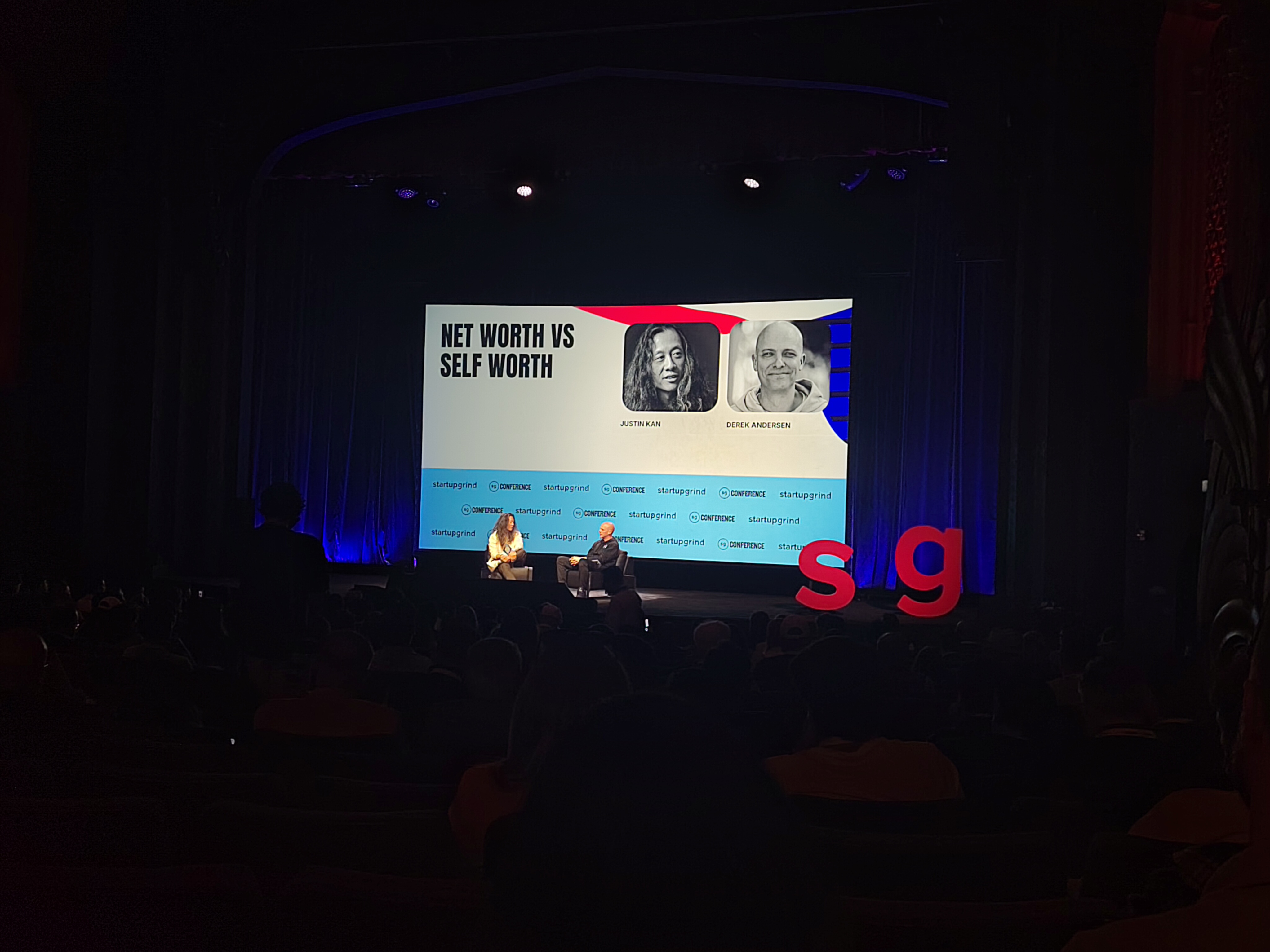
Last week I attended Startup Grind Global in Redwood City, CA. I find it can be helpful to get boots on the ground to hear first hand what’s happening in the industry. Here are my six key takeaways, grouped by theme.
As you can probably guess, there was a lot of AI talk, so please bear in mind there is always going to be some hyperbole and exaggeration at conference talks; it benefits people to big up their industry. The core concepts shared in our “AI for Business” livestream series still ring true; start with a problem you want to solve, look at your processes from end-to-end and then look at tools that can help you.
Recordings of all the talks are available on Startup Grind’s YouTube.
Pace of change in AI
You don’t need to spend long walking the streets of San Francisco to see that change is afoot. The pace of this change is what surprised me most though, with many speakers at Startup Grind labelling companies formed pre 2022 as “legacy companies”.
It certainly feels like a land-grab is underway with enterprises under pressure from their boards to pick their AI tools in the next 6-9 months. It’s accelerating, and AI-native companies seem to have an edge (although I believe some of this is smoke and mirrors).
What seems to be more concrete is that we’re moving from “rented intelligence” to “owned intelligence”. Large frontier models have been used as a general purpose solution to solve many problems. Now though, smaller models trained on specific customer data are coming to the fore. This is because you don’t need frontier level intelligence to solve a lot of tasks. The question is not which model is the smartest, but which model is the most efficient at completing a task without compromising quality.
The future is likely some combination of the two approaches. Some problems will be solved by large frontier models, but many others will be better suited to models that are trained specifically on your own customer data. Therefore, it is important to own the stack; the model and the data. That’s the most valuable layer, and you need to own it.
What still matters
One thing I heard consistently across most talks is that taste and judgement are the most valuable skills to have in this rapidly changing space.
You may have expertise in a specific tool or process, but if that workflow gets replaced or automated, those expertise become less valuable. However, even if we reach a point where an individual is managing a team of productive agents, there could be even more work for you to do on the back of all that output. You’re going to have to make those critical judgement calls for all the agents’ work.
So it’s important to make AI work for you, not the other way around. It’s a tool, but you need to make the decisions. Being opinionated helps in this regard. And if you want to explore some of thoughtbot’s strongly held opinions, check out “The opinionated thoughtbotter” series.
Marketing & Pricing
It can also be challenging to market your company in such a fluid environment where new work is being shipped constantly. How do you keep a consistent message? Well, the best companies are now shipping fast and iteratively, but the narrative around their brand always stays the same. It’s consistent and is tied to the same company mission.
Your product marketing can be more functional but your brand marketing needs to be emotive; it’s about how you make people feel. The best marketing focuses on the problem, not the solution.
In terms of pricing, consumption based pricing is all the rage currently, while people have been predicting the downfall of SaaS for the last couple of years. But the sentiment I heard is that the pendulum will probably swing back to some form of bundle pricing because consumption based pricing is hard for enterprises to control. The trick here will be creating different consumption buckets that work for your customers, so the two pricing methods are merging to some degree.
Future founders
Given this was Startup Grind, a lot of the advice was focused on founders. This is an exciting time to be a founder, comparable to the opportunities that existed around the iPhone in 2010. As a founder, you have an opportunity to create an entirely new future and to bring customers along for the ride. The next great founders won’t just be bolting AI on something people already use, but they’ll be changing what people do completely. To pull this off, you need to be bold, opinionated and even contrarian.
Entrepreneurial spirit is in high demand in early stage teams too. With the pace of change, finding people who are resourceful, hungry and who get things done is more important than specific skills or impressive backgrounds.
Finally, if you are heading down the fundraising route, it is almost impossible to raise money with just a pitch deck (for software products at least). The conventional wisdom seems to be that, with AI coding agents, you need a working prototype and customers to raise capital.
Agentic havoc
While agents can be helpful, they can also create devastating problems. One example is supply chain attacks, like the recent one at Mercor. These types of attacks are becoming more prevalent and can be introduced, for example, when someone uses Claude Code to install packages that inadvertently create security issues.
The advice is to never connect a coding agent to production data because it can install, run or, worst of all, delete anything. Incident responses, design reviews, and auditing and tracking who made changes are all becoming even more important with agents in the mix. Security, therefore, is a real area of opportunity for companies to exploit.
The future of designers
As a Product Designer, I was particularly interested in hearing about the future of design at this conference. In the lead up to it, with the release of Claude Design, there have been a lot of click-bait articles and videos online predicting the demise of the design field.
While the “no UI” concept is a trendy idea, I saw some pushback against it. The feeling seems to be that someone, somewhere during the process, will have to do something, so there’s still going to be a need for a clean, human-centered UI. If we reach a point where an individual is managing a fleet of agents, having a simple, easy and beautiful UI for managing these agents will be the frontier of design.
In terms of UX, in a world where anyone can create anything, the experts actually felt UX is going to be more important than ever. So good design isn’t going away.
My favourite talk of the conference was a fireside chat between Karri Saarinen (CEO and co-founder of Linear) and Stephanie Zhan (a Partner in Sequoia Capital). They discussed design and AI. Karri began his career as a designer so I was particularly interested in what he had to say on this topic. While I recommend watching the talk in full, the key takeaways I pulled from it were:
- Good design is a way to build trust and could be a competitive advantage. It shows you put lots of thought into your product, which is reassuring for potential customers. You still need to ship fast to test, but there’s a balance to be struck. This point was actually made during the Q&A they did after the original talk, so it’s not in the recording above.
- In relation to AI design tools, Karri made the point that even if these tools can generate designs that look good, it doesn’t mean those designs work well. He still uses Figma at the planning stage when he designs because writing something out helps him organise his thoughts. This act gives you some real value that shouldn’t be overlooked in favour of “vibe-designed” applications.
- Karri believes that output isn’t design. It’s not the act of producing that is valuable, it’s about understanding the problem well enough to understand what, how and if something should exist. Karri felt there could be a pendulum swing back, moving away from building loads of things quickly and towards being more thoughtful and intentional about what is being built.
- Undoubtedly some aspects of design will change. AI is increasing the floor of design in some areas and automating others. The drawing of rectangles will be less important in future. But Karri made the point that if you don’t understand design you’ll use these AI design tools incorrectly. If you don’t trust AI to do your legal work, then why would you trust it to do design?
- Finally, the default career direction seems to be that design and designers move closer to code. But Karri felt there is an opportunity for ambitious designers to move upstream into leadership positions where they can answer questions like what we should be building, whether we should build something at all, what’s the product direction and so on.
3 cool companies:
Finally, here are three cool companies that stood out to me from the conference that you may not have heard of. Definitely work checking out!
- Hydram Research - An Icelandic company building novel, large-scale hardware that makes it more energy efficient to produce steam, which is critical in nearly all material manufacturing processes, from plastics to paper.
- Samaya AI - As thoughtbot are experts in the regulated industries, including financial services, Samaya caught my eye. Samaya equips financial professionals with secure, market-fluent AI agents to answer questions, deliver insights, and automate workflows.
- Condor - An AI-powered early detection system to prevent the spread of wildfires. They claim to reduce response time from between 30 and 120 minutes to between 1 and 10 minutes.