---
title: This is your threading bug
teaser: 'Solving these bugs often involves doing less, but thinking through them can
  be tricky.

  '
tags: programming,bug,computer science,good code
author: Mike Burns
published_on: 2020-05-19
---

A race condition bug is a common class of bugs that occur when a sequence of
actions assumes a state, but the state can be modified from an external source.
We'll go in depth in many examples, but a quick example is a mobile app that
assumes a data connection exists because you had previously performed an API
call; the state of the network is controlled by an external source. These two
representations of network state are in a race for the next network call.

A special case of race condition is the
[time-of-check to time-of-use](https://cwe.mitre.org/data/definitions/367.html)
(<abbr title="Time-Of-Check to Time-Of-Use">TOCTOU</abbr>) bug. These bugs deal
with the distance between checking the state to using the knowledge of the
state.  Continuing the above example: checking whether you have a network
connection, and then sending a HTTP request with the assumption that it will
work. That network check might have been the network's last breath before the
phone enters a tunnel, thus presenting a TOCTOU bug.

These bugs are subtle, frequent, tricky to debug, and in some cases a [security
concern]. In this article let's examine some of the more common ones in the hope
that we can internalize the fundamental structure, gain an intuition for
recognizing this class of bugs, and avoid these classic examples in our own
code.

[security concern]: https://cve.mitre.org/cgi-bin/cvekey.cgi?keyword=toctou

("TOCTOU" is not pronouced "toucan", which is a disappointment to us all.)

## Networks

The first example we'll dive into is the one mentioned in the intro: checking
for network connectivity before making the request. Here's an example in Ruby;
it contains a TOCTOU bug:

<figure>

<!--
def request(req)
  if has_connection?(req)
    Net::HTTP.start(req.host, req.port) { |http| http.request(req) }
  end
end

def has_connection?(req)
  Addrinfo.getaddrinfo(req.host, req.port)
rescue SocketError
  false
end
-->

<div class="highlight"><pre class="highlight ruby"><code><span class="k">def</span> <span class="nf">request</span><span class="p">(</span><span class="n">req</span><span class="p">)</span>&#x000A;  <span class="k">if</span> <span class="n">has_connection?</span><span class="p">(</span><span class="n">req</span><span class="p">)</span>&#x000A;    <span class="no">Net</span><span class="o">::</span><span class="no">HTTP</span><span class="p">.</span><span class="nf">start</span><span class="p">(</span><span class="n">req</span><span class="p">.</span><span class="nf">host</span><span class="p">,</span> <span class="n">req</span><span class="p">.</span><span class="nf">port</span><span class="p">)</span> <span class="p">{</span> <span class="o">|</span><span class="n">http</span><span class="o">|</span> <span class="n">http</span><span class="p">.</span><span class="nf">request</span><span class="p">(</span><span class="n">req</span><span class="p">)</span> <span class="p">}</span>&#x000A;  <span class="k">end</span>&#x000A;<span class="k">end</span>&#x000A;&#x000A;<span class="k">def</span> <span class="nf">has_connection?</span><span class="p">(</span><span class="n">req</span><span class="p">)</span>&#x000A;  <span class="no">Addrinfo</span><span class="p">.</span><span class="nf">getaddrinfo</span><span class="p">(</span><span class="n">req</span><span class="p">.</span><span class="nf">host</span><span class="p">,</span> <span class="n">req</span><span class="p">.</span><span class="nf">port</span><span class="p">)</span>&#x000A;<span class="k">rescue</span> <span class="no">SocketError</span>&#x000A;  <span class="kp">false</span>&#x000A;<span class="k">end</span>&#x000A;</code></pre></div>

<figcaption>
This sample of a TOCTOU bug defines a `request` method that makes a HTTP
request, returning the result if there is a network connection, or `nil`.
It tests for a network connection via a DNS lookup.
</figcaption>
</figure>

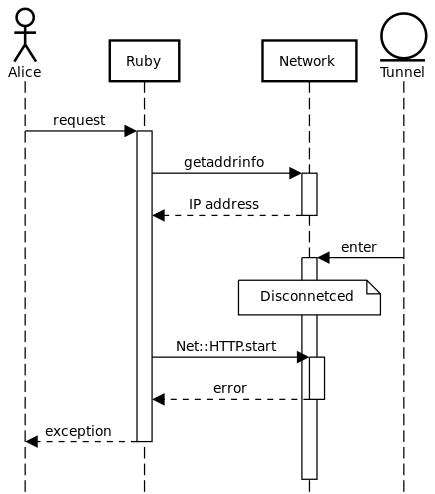
This example exhibits the TOCTOU bug: it has a gap between the time of check
and the time of use. We can use a sequence diagram to understand this gap:

<figure>

<img
src="https://images.thoughtbot.com/toucan/X3PqnKJSOqaZ6J6aFgE4_network-toctou.png"
alt="getaddrinfo returns success before we enter the tunnel but Net::HTTP.start fails after">

<figcaption>
The `request` method starts with a connected network. The `has_connection?` and
subsequent `getaddrinfo` call happen while the network is connected, but the
network disconnects immediately after returning from `getaddrinfo`. This leaves
the `Net::HTTP.start` in the false belief that the network is connected.
</figcaption>
</figure>

The Ruby code seems sequential, but the state the program is tracking is
a snapshot of state that is controlled externally. If the Ruby program uses its
last network touchpoint to check for access instead of sending the HTTP
request, we will see unexpected errors.

The correct way to solve this is hinted at in `has_connection?`. We already
have to handle an exception; that is how the `Addrinfo.getaddrinfo` method
communicates its return value. Therefore, we can make the HTTP call and handle
the exception all in one swoop:

<figure>

<!--
HTTP_ERRORS = [
  EOFError,
  Errno::ECONNRESET,
  Errno::EINVAL,
  Net::HTTPBadResponse,
  Net::HTTPHeaderSyntaxError,
  Net::ProtocolError,
  SocketError,
  Timeout::Error,
]

def request(req)
  Net::HTTP.start(req.host, req.port) { |http| http.request(req) }
rescue *HTTP_ERRORS
  nil
end
-->

<div class="highlight"><pre class="highlight ruby"><code><span class="no">HTTP_ERRORS</span> <span class="o">=</span> <span class="p">[</span>&#x000A;  <span class="no">EOFError</span><span class="p">,</span>&#x000A;  <span class="no">Errno</span><span class="o">::</span><span class="no">ECONNRESET</span><span class="p">,</span>&#x000A;  <span class="no">Errno</span><span class="o">::</span><span class="no">EINVAL</span><span class="p">,</span>&#x000A;  <span class="no">Net</span><span class="o">::</span><span class="no">HTTPBadResponse</span><span class="p">,</span>&#x000A;  <span class="no">Net</span><span class="o">::</span><span class="no">HTTPHeaderSyntaxError</span><span class="p">,</span>&#x000A;  <span class="no">Net</span><span class="o">::</span><span class="no">ProtocolError</span><span class="p">,</span>&#x000A;  <span class="no">SocketError</span><span class="p">,</span>&#x000A;  <span class="no">Timeout</span><span class="o">::</span><span class="no">Error</span><span class="p">,</span>&#x000A;<span class="p">]</span>&#x000A;&#x000A;<span class="k">def</span> <span class="nf">request</span><span class="p">(</span><span class="n">req</span><span class="p">)</span>&#x000A;  <span class="no">Net</span><span class="o">::</span><span class="no">HTTP</span><span class="p">.</span><span class="nf">start</span><span class="p">(</span><span class="n">req</span><span class="p">.</span><span class="nf">host</span><span class="p">,</span> <span class="n">req</span><span class="p">.</span><span class="nf">port</span><span class="p">)</span> <span class="p">{</span> <span class="o">|</span><span class="n">http</span><span class="o">|</span> <span class="n">http</span><span class="p">.</span><span class="nf">request</span><span class="p">(</span><span class="n">req</span><span class="p">)</span> <span class="p">}</span>&#x000A;<span class="k">rescue</span> <span class="o">*</span><span class="no">HTTP_ERRORS</span>&#x000A;  <span class="kp">nil</span>&#x000A;<span class="k">end</span>&#x000A;</code></pre></div>

<figcaption>
This re-definition of the `#request` method makes the HTTP call immediately,
relying on exceptions to communicate network disconnections. The underlying
network libraries can raise a slew of exceptions, so we define a constant
`HTTP_ERRORS` to format them more neatly.
</figcaption>
</figure>

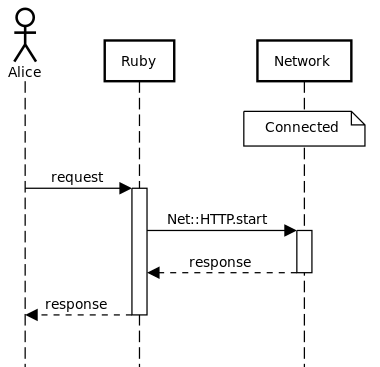
This has the added advantage of making only one network call, instead of two.
The sequence diagram is much simpler now:

<figure>

<img
src="https://images.thoughtbot.com/toucan/2a7UYAUQRX27TpF277zQ_network-exn.png"
alt="Make the Net::HTTP.start call without any checks and ignore the tunnel">

<figcaption>
The `request` method starts with a connected network. It makes the
`Net::HTTP.start` call immediately. It does not try to track the network state,
and handles errors as they come.
</figcaption>
</figure>

The network example is nice because it's familiar and also a good template.
It's familiar as a user: you've definitely experienced bugs in mobile
apps that assumed you had network connectivity because you previously had
network connectivitity. It's also familiar as a programmer: the network APIs we
use all work via a exception-based pattern, and all examples are like the
above. In this way it also provides a good template: move from an explicit
conditional (asking permission) to a model where we do the action we want to do
and handle the failure (asking forgiveness).

Note that a variant of this pattern holds for languages without exceptions.
Many of these are too verbose for a blog post, but for example the Rust
[`reqwest::get`] function returns a [`Result<Response>`] value instead of just
`Response`, indicating that it can have an [`Error`]. Similarly in the C
libcurl library, the [`curl_easy_perform(3)`] function returns `CURLE_OK` on
success and [non-zero on error], allowing you to make a request and handle the
errors manually.

[`reqwest::get`]: https://docs.rs/reqwest/0.10.4/reqwest/fn.get.html
[`Result<Response>`]: https://docs.rs/reqwest/0.10.4/reqwest/type.Result.html
[`Error`]: https://docs.rs/reqwest/0.10.4/reqwest/struct.Error.html
[`curl_easy_perform(3)`]: https://curl.haxx.se/libcurl/c/curl_easy_perform.html
[non-zero on error]: https://curl.haxx.se/libcurl/c/libcurl-errors.html

## Files

Let's play Spot The Bug with this code sample:

<figure>

<!--
def eval_gemfile
  if File.exist?("Gemfile.local")
    eval(File.read("Gemfile.local"))
  end
end
-->

<div class="highlight"><pre class="highlight ruby"><code><span class="k">def</span> <span class="nf">eval_gemfile</span>&#x000A;  <span class="k">if</span> <span class="no">File</span><span class="p">.</span><span class="nf">exist?</span><span class="p">(</span><span class="s2">"Gemfile.local"</span><span class="p">)</span>&#x000A;    <span class="nb">eval</span><span class="p">(</span><span class="no">File</span><span class="p">.</span><span class="nf">read</span><span class="p">(</span><span class="s2">"Gemfile.local"</span><span class="p">))</span>&#x000A;  <span class="k">end</span>&#x000A;<span class="k">end</span>&#x000A;</code></pre></div>

<figcaption>
This is a simple method that reads the contents of a file named `Gemfile.local`
into memory, but only if the file exists. This exposes a TOCTOU bug.
</figcaption>
</figure>

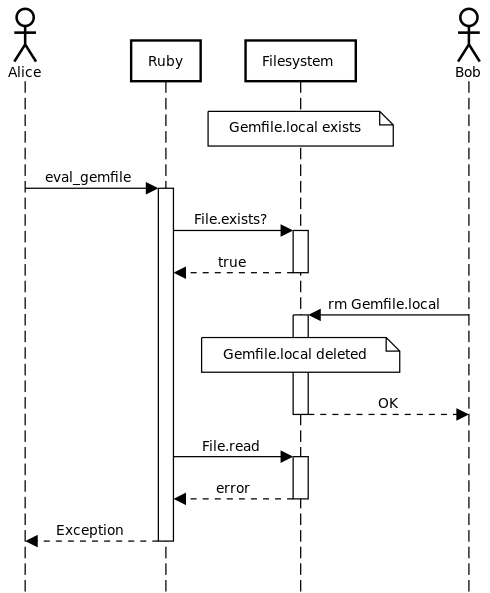
This shape looks identical to the buggy network code above. Here's an example
sequence diagram:

<figure>

<img
src="https://images.thoughtbot.com/toucan/qFxiwcuCRAGq9DAgQ9bv_filesystem-toctou.png"
alt="Checking a file before reading from it means it can be deleted in between">

<figcaption>
In this sequence the `Gemfile.local` file exists at the start of `eval_gemfile`
and during the call to `File.exist?`, but an outside force deletes it before we
get to the `File.read`.
</figcaption>
</figure>

This sequence diagram shows the bug: Ruby's state of the filesystem does not
match the actual state of the filesystem. We can recover this with exceptions,
as we did with the network example:

<figure>

<!--
def eval_gemfile
  eval(File.read("Gemfile.local"))
rescue Errno::ENOENT
end
-->

<div class="highlight"><pre class="highlight ruby"><code><span class="k">def</span> <span class="nf">eval_gemfile</span>&#x000A;  <span class="nb">eval</span><span class="p">(</span><span class="no">File</span><span class="p">.</span><span class="nf">read</span><span class="p">(</span><span class="s2">"Gemfile.local"</span><span class="p">))</span>&#x000A;<span class="k">rescue</span> <span class="no">Errno</span><span class="o">::</span><span class="no">ENOENT</span>&#x000A;<span class="k">end</span>&#x000A;</code></pre></div>

<figcaption>
This is a simple method that reads the contents of a file named `Gemfile.local`
into memory. If the file does not exist `File.read` raises `Errno::ENOENT`, but
we rescue and silence that one exception. This is equivalent to the prior
example but without the TOCTOU bug.
</figcaption>
</figure>

The chance of this but appearing is low, but the ability to debug it even
lower. This kind of bug can be exploited due to the complexities of how
operating systems schedule processes and threads. After each operation there's
a good chance your program will stop for an unknown amount of time while other
processes run. The arbitrary and seemingly random nature of this means that
these kind of bugs can occur, and can be impossible to reproduce.

### File security

A more subtle, security-sensitive bug can occur when checking permission and
file access. For example, this has a bug:

<figure>

<!--
def print_secrets
  if has_access?("secrets")
    puts File.read("secrets")
  end
end

def has_access?(filename)
  status = File.new(filename).stat
  status.file? && status.owned?
end
-->

<div class="highlight"><pre class="highlight ruby"><code><span class="k">def</span> <span class="nf">print_secrets</span>&#x000A;  <span class="k">if</span> <span class="n">has_access?</span><span class="p">(</span><span class="s2">"secrets"</span><span class="p">)</span>&#x000A;    <span class="nb">puts</span> <span class="no">File</span><span class="p">.</span><span class="nf">read</span><span class="p">(</span><span class="s2">"secrets"</span><span class="p">)</span>&#x000A;  <span class="k">end</span>&#x000A;<span class="k">end</span>&#x000A;&#x000A;<span class="k">def</span> <span class="nf">has_access?</span><span class="p">(</span><span class="n">filename</span><span class="p">)</span>&#x000A;  <span class="n">status</span> <span class="o">=</span> <span class="no">File</span><span class="p">.</span><span class="nf">new</span><span class="p">(</span><span class="n">filename</span><span class="p">).</span><span class="nf">stat</span>&#x000A;  <span class="n">status</span><span class="p">.</span><span class="nf">file?</span> <span class="o">&amp;&amp;</span> <span class="n">status</span><span class="p">.</span><span class="nf">owned?</span>&#x000A;<span class="k">end</span>&#x000A;</code></pre></div>

<figcaption>
The `print_secrets` method checks whether the user should have access to the
`secrets` file and, if so, prints its contents. The access check is done using
the OS `stat(2)` function. The business logic is that a user has access to a
file if it is a regular file and the user owns it. This implementation has a
TOCTOU bug.
</figcaption>
</figure>

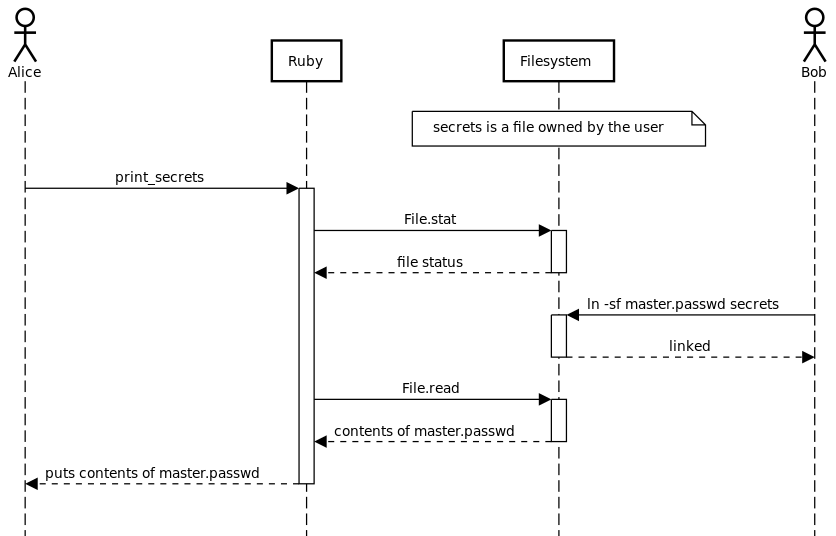
The TOCTOU bug becomes apparent under a sequence diagram showing the attack:

<figure>

<img
src="https://images.thoughtbot.com/toucan/HltYqB0AT4dsmFUDaeOg_filesystem-security-toctou.png"
alt="Checking a file's permissions before reading from it opens us up to symlink attacks">

<figcaption>
In this sequence diagram the `print_secrets` method begins with `secrets`
under the user's control and as a file. We perform the `File.stat`, which
confirms this. Then the attacker removes `secrets`, replacing it with a link to
`/etc/master.passwd` -- the file containing not just user account names but
also the user's passwords. Ruby calls `File.read` on this symlink.
</figcaption>
</figure>

This example shows a much more difficult consideration than the above. If an
attacker can know when `File.stat` is called vs `File.read`, they can manipulate
the program into opening an unexpected file. The reason this example is much
more difficult is because there's no good solution here. Not all TOCTOU bugs
are as trivial to solve as the file existence example. However, we should try
to rely on underlying filesystem permissions as much as possible. This is
harder to mitigate, which means that [this kind of bug does happen in the
wild].

[this kind of bug does happen in the wild]: https://seclists.org/oss-sec/2019/q2/131

<figure>

<!--
def print_secrets
  file = File.new("secrets")
  contents = file.read

  if has_permission?(file)
    puts contents
  end
rescue Errno::EACCES
end

def has_permission?(file)
  status = file.stat
  status.file? && status.owned?
end
-->

<div class="highlight"><pre class="highlight ruby"><code><span class="k">def</span> <span class="nf">print_secrets</span>&#x000A;  <span class="n">file</span> <span class="o">=</span> <span class="no">File</span><span class="p">.</span><span class="nf">new</span><span class="p">(</span><span class="s2">"secrets"</span><span class="p">)</span>&#x000A;  <span class="n">contents</span> <span class="o">=</span> <span class="n">file</span><span class="p">.</span><span class="nf">read</span>&#x000A;&#x000A;  <span class="k">if</span> <span class="n">has_permission?</span><span class="p">(</span><span class="n">file</span><span class="p">)</span>&#x000A;    <span class="nb">puts</span> <span class="n">contents</span>&#x000A;  <span class="k">end</span>&#x000A;<span class="k">rescue</span> <span class="no">Errno</span><span class="o">::</span><span class="no">EACCES</span>&#x000A;<span class="k">end</span>&#x000A;&#x000A;<span class="k">def</span> <span class="nf">has_permission?</span><span class="p">(</span><span class="n">file</span><span class="p">)</span>&#x000A;  <span class="n">status</span> <span class="o">=</span> <span class="n">file</span><span class="p">.</span><span class="nf">stat</span>&#x000A;  <span class="n">status</span><span class="p">.</span><span class="nf">file?</span> <span class="o">&amp;&amp;</span> <span class="n">status</span><span class="p">.</span><span class="nf">owned?</span>&#x000A;<span class="k">end</span>&#x000A;</code></pre></div>

<figcaption>
This `#print_secrets` implementation also has a TOCTOU bug, but it is harder to
exploit. We first create a file handle via `File.new`; this can raise
`Errno::EACCES` if the user does not have permissions to read this file, which
we handle explicitly. After reading the contents of the file we additionally
check the permission of the filehandle we read, and only print the contents
if that matches.
</figcaption>

</figure>

This is harder to exploit because the attacker needs to time calls to
`#print_secrets` instead of `File.stat`, which is presumably more
user-dependent. In addition, note that we now handle the exception for a file
that we cannot access.

## Authorization

The above examples are ones where the external state is under the control of a
different entity -- the network stack or the filesystem. As a last example
let's talk about what infrastructure you need to build to when plan around
TOCTOU bugs.

Let's use the example of authorization: a user needs to be able to do the
things they are able to do, and nothing more (or less!). Some examples of what
users can do are read, publish, delete, delete other content, and create
admins.

<table>
  <tr>
    <th>User type</th>
    <th>Can read?</th>
    <th>Can publish?</th>
    <th>Can delete their own content?</th>
    <th>Can delete other content?</th>
    <th>Can create admins?</th>
  </tr>
  <tr>
    <th>Visitor</th>
    <td>Yes</td>
    <td>No</td>
    <td>No</td>
    <td>No</td>
    <td>No</td>
  </tr>
  <tr>
    <th>User</th>
    <td>Yes</td>
    <td>Yes</td>
    <td>Yes</td>
    <td>No</td>
    <td>No</td>
  </tr>
  <tr>
    <th>Moderator</th>
    <td>Yes</td>
    <td>Yes</td>
    <td>Yes</td>
    <td>Yes</td>
    <td>No</td>
  </tr>
  <tr>
    <th>Admin</th>
    <td>Yes</td>
    <td>Yes</td>
    <td>Yes</td>
    <td>Yes</td>
    <td>Yes</td>
  </tr>
</table>

If you check what a user can do when they sign in, you are storing that state
for as long as they are authenticated. Here's an example of buggy
authorization code:

<figure>

<!--
class SignInsController < ApplicationController
  def create
    if user = User.authorize_by(params[:email], params[:password])
      session[:user] = {
        id: user.to_param,
        can_read: user.can_read?,
        can_write: user.can_write?,
        can_delete: user.can_delete?,
        can_moderate: user.can_moderate?,
        can_promote: user.can_promote?,
      }
      redirect_to dashboard_path
    else
      flash.now[:error] = I18n.t(".incorrect_username_or_password")
      render :new
    end
  end
end
-->

<div class="highlight"><pre class="highlight ruby"><code><span class="k">class</span> <span class="nc">SignInsController</span> <span class="o">&lt;</span> <span class="no">ApplicationController</span>&#x000A;  <span class="k">def</span> <span class="nf">create</span>&#x000A;    <span class="k">if</span> <span class="n">user</span> <span class="o">=</span> <span class="no">User</span><span class="p">.</span><span class="nf">authorize_by</span><span class="p">(</span><span class="n">params</span><span class="p">[</span><span class="ss">:email</span><span class="p">],</span> <span class="n">params</span><span class="p">[</span><span class="ss">:password</span><span class="p">])</span>&#x000A;      <span class="n">session</span><span class="p">[</span><span class="ss">:user</span><span class="p">]</span> <span class="o">=</span> <span class="p">{</span>&#x000A;        <span class="ss">id: </span><span class="n">user</span><span class="p">.</span><span class="nf">to_param</span><span class="p">,</span>&#x000A;        <span class="ss">can_read: </span><span class="n">user</span><span class="p">.</span><span class="nf">can_read?</span><span class="p">,</span>&#x000A;        <span class="ss">can_write: </span><span class="n">user</span><span class="p">.</span><span class="nf">can_write?</span><span class="p">,</span>&#x000A;        <span class="ss">can_delete: </span><span class="n">user</span><span class="p">.</span><span class="nf">can_delete?</span><span class="p">,</span>&#x000A;        <span class="ss">can_moderate: </span><span class="n">user</span><span class="p">.</span><span class="nf">can_moderate?</span><span class="p">,</span>&#x000A;        <span class="ss">can_promote: </span><span class="n">user</span><span class="p">.</span><span class="nf">can_promote?</span><span class="p">,</span>&#x000A;      <span class="p">}</span>&#x000A;      <span class="n">redirect_to</span> <span class="n">dashboard_path</span>&#x000A;    <span class="k">else</span>&#x000A;      <span class="n">flash</span><span class="p">.</span><span class="nf">now</span><span class="p">[</span><span class="ss">:error</span><span class="p">]</span> <span class="o">=</span> <span class="no">I18n</span><span class="p">.</span><span class="nf">t</span><span class="p">(</span><span class="s2">".incorrect_username_or_password"</span><span class="p">)</span>&#x000A;      <span class="n">render</span> <span class="ss">:new</span>&#x000A;    <span class="k">end</span>&#x000A;  <span class="k">end</span>&#x000A;<span class="k">end</span>&#x000A;</code></pre></div>

<figcaption>
This Rails controller mixes authorization into authentication. When the user
authenticates correctly, we stuff their abilities into the session. This sets
us up for a TOCTOU bug.
</figcaption>
</figure>

Setting authorization details once at sign-in means that any future check is
static. Here's an example of a buggy method of checking whether a user is an
admin:

```ruby
def can_promote?
  session[:user][:can_promote]
end
```

If the user is promoted, they will need to sign out and back in to see the
effects. This is something the user wants, so they'll be encouraged to do so.
However, if the user is demoted or otherwise moderated by the admins, they will
not feel the effects until they re-authenticate -- which they have no interest
in doing.

The TOCTOU bug may go deeper. Let's look at some example code that shows the
link to the admin page, the controller backing it, and the model code:

<figure>

<!--
erb
<nav>
  <ul>
    <li><%= link_to "Write new post", new_article_path %></li>
    <% if can_promote? %>
      <li><%= link_to "Promote user", new_promotions_path %></li>
    <% end %>
  </ul>
</nav>

ruby
class PromotionsController < ApplicationController
  def new
    @user = User.new
  end

  def create
    @user = User.find(params[:user_id])

    if @user.promote
      redirect_to new_promotions_path
    else
      render :new
    end
  end
end

class User < ActiveRecord::Base
  def promote
    update(can_promote: true)
  end
end
-->

<div class="highlight"><pre class="highlight erb"><code><span class="nt">&lt;nav&gt;</span>&#x000A;  <span class="nt">&lt;ul&gt;</span>&#x000A;    <span class="nt">&lt;li&gt;</span><span class="cp">&lt;%=</span> <span class="n">link_to</span> <span class="s2">"Write new post"</span><span class="p">,</span> <span class="n">new_article_path</span> <span class="cp">%&gt;</span><span class="nt">&lt;/li&gt;</span>&#x000A;    <span class="cp">&lt;%</span> <span class="k">if</span> <span class="n">can_promote?</span> <span class="cp">%&gt;</span>&#x000A;      <span class="nt">&lt;li&gt;</span><span class="cp">&lt;%=</span> <span class="n">link_to</span> <span class="s2">"Promote user"</span><span class="p">,</span> <span class="n">new_promotions_path</span> <span class="cp">%&gt;</span><span class="nt">&lt;/li&gt;</span>&#x000A;    <span class="cp">&lt;%</span> <span class="k">end</span> <span class="cp">%&gt;</span>&#x000A;  <span class="nt">&lt;/ul&gt;</span>&#x000A;<span class="nt">&lt;/nav&gt;</span>&#x000A;</code></pre></div>

<div class="highlight"><pre class="highlight ruby"><code><span class="k">class</span> <span class="nc">PromotionsController</span> <span class="o">&lt;</span> <span class="no">ApplicationController</span>&#x000A;  <span class="k">def</span> <span class="nf">new</span>&#x000A;    <span class="vi">@user</span> <span class="o">=</span> <span class="no">User</span><span class="p">.</span><span class="nf">new</span>&#x000A;  <span class="k">end</span>&#x000A;&#x000A;  <span class="k">def</span> <span class="nf">create</span>&#x000A;    <span class="vi">@user</span> <span class="o">=</span> <span class="no">User</span><span class="p">.</span><span class="nf">find</span><span class="p">(</span><span class="n">params</span><span class="p">[</span><span class="ss">:user_id</span><span class="p">])</span>&#x000A;&#x000A;    <span class="k">if</span> <span class="vi">@user</span><span class="p">.</span><span class="nf">promote</span>&#x000A;      <span class="n">redirect_to</span> <span class="n">new_promotions_path</span>&#x000A;    <span class="k">else</span>&#x000A;      <span class="n">render</span> <span class="ss">:new</span>&#x000A;    <span class="k">end</span>&#x000A;  <span class="k">end</span>&#x000A;<span class="k">end</span>&#x000A;&#x000A;<span class="k">class</span> <span class="nc">User</span> <span class="o">&lt;</span> <span class="no">ActiveRecord</span><span class="o">::</span><span class="no">Base</span>&#x000A;  <span class="k">def</span> <span class="nf">promote</span>&#x000A;    <span class="n">update</span><span class="p">(</span><span class="ss">can_promote: </span><span class="kp">true</span><span class="p">)</span>&#x000A;  <span class="k">end</span>&#x000A;<span class="k">end</span>&#x000A;</code></pre></div>

<figcaption>
The ERb template uses our `#can_promote?` helper to decide whether to show a
link to the user promotions form. The `create` action for the promotions
controller finds a user, promotes them, and redirects. Promoting a user
(`User#promote`) simply updates the `can_promote` field in the database. The
`User#promote` method is in a style that enforces a TOCTOU bug.
</figcaption>

</figure>

When designing your system, you can avoid introducing TOCTOU bugs by delaying
any checks until the last moment, and relying on a "ask forgiveness, not
permission" mindset.

A bug-free version of `#can_promote?` would go directly to the database every
time:

```ruby
def can_promote?
  current_user.can_promote?
end
```

But it goes deeper: the actual check must happen in the model layer. It is the
last safeguard of the data and the keeper of authorization state.

<figure>

<!--
class User < ActiveRecord::Base
  def promote_by!(promoter_id)
    transaction do
      promoter = self.class.lock.find_by(
        id: promoter_id,
        can_promote: true,
      )

      if promoter
        update!(can_promote: true)
      else
        raise ArgumentError, "can only be promoted by an admin"
      end
    end
  end
end
-->

<div class="highlight"><pre class="highlight ruby"><code><span class="k">class</span> <span class="nc">User</span> <span class="o">&lt;</span> <span class="no">ActiveRecord</span><span class="o">::</span><span class="no">Base</span>&#x000A;  <span class="k">def</span> <span class="nf">promote_by!</span><span class="p">(</span><span class="n">promoter_id</span><span class="p">)</span>&#x000A;    <span class="n">transaction</span> <span class="k">do</span>&#x000A;      <span class="n">promoter</span> <span class="o">=</span> <span class="nb">self</span><span class="p">.</span><span class="nf">class</span><span class="p">.</span><span class="nf">lock</span><span class="p">.</span><span class="nf">find_by</span><span class="p">(</span>&#x000A;        <span class="ss">id: </span><span class="n">promoter_id</span><span class="p">,</span>&#x000A;        <span class="ss">can_promote: </span><span class="kp">true</span><span class="p">,</span>&#x000A;      <span class="p">)</span>&#x000A;&#x000A;      <span class="k">if</span> <span class="n">promoter</span>&#x000A;        <span class="n">update!</span><span class="p">(</span><span class="ss">can_promote: </span><span class="kp">true</span><span class="p">)</span>&#x000A;      <span class="k">else</span>&#x000A;        <span class="k">raise</span> <span class="no">ArgumentError</span><span class="p">,</span> <span class="s2">"can only be promoted by an admin"</span>&#x000A;      <span class="k">end</span>&#x000A;    <span class="k">end</span>&#x000A;  <span class="k">end</span>&#x000A;<span class="k">end</span>&#x000A;</code></pre></div>

<figcaption>
We've replaced `User#promote` with `User#promote_by!`, which takes the ID of
a user doing a promoting, executes everything inside a database transaction,
finds and locks the promoting user only if they are an admin, and only promotes
the user if the promoting user exists.
</figcaption>

</figure>

The prior method for promoting a user, `User#promote`, is replaced with one
that tracks details on both users, `User#promote_by!`. This allows us to
perform checks at the lowest level.

We want an atomic world with the latest values, so we run two database queries
inside a transaction. The first query is for a user that matches our promoter's
ID and also has the permission required to perform the promotion. The second
query is the update itself.

There remains a chance that the promoting user will be updated outside of this
transaction, so we lock that row for consistency.

We choose to switch to exceptions here for consistency with other examples in
Ruby where we try to avoid TOCTOU bugs, such as in networking or file code, and
also because `ActiveRecord::Base#transaction` requires that.

## Conclusion

When dealing with files, keep an eye on `stat(2)` calls, such as `File.exist?`
in Ruby, `test -e` in shell, or `stat()` in C. These indicate potential bugs,
and you may be able to re-write them using exceptions instead.

When working with or designing a system, take note of when you're tracking
state and who can control that state. If it can be modified by an external
actor -- a train tunnel, the user in another shell, the user opening another
tab, or a security-minded attacker -- then you have the potential for a
time-of-check to time-of-use bug.

TOCTOU bugs range in severity from simply being tricky to track down to actual
security issues. It is in the best interest for you and your users to build
your software to avoid TOCTOU bugs. Take note of the textbook examples to avoid
those in general.

The underlying principle to avoid a TOCTOU bug is "ask for forgiveness, not for
permission". This can be seen as another form of "[tell, don't ask]", and can
also be seen as a form of [Law of Demeter]. The object that maintains the
resource is the final authority on the resource's state, and tracking the state
elsewhere is setting yourself up for a TOCTOU bug.

[tell, don't ask]: https://thoughtbot.com/blog/tell-dont-ask
[Law of Demeter]: https://www.ccs.neu.edu/home/lieber/LoD.html
