---
title: Shared Terminology Yet Different Concepts Between Ember.js and Rails
teaser:
tags: web,rails,ember,javascript
author: Tute Costa
published_on: 2014-06-12
---
Developers who are well versed in Ruby on Rails (or other MVC implementations) and start learning Ember.js may
find it surprising that, even though there's shared vocabulary, denoted concepts
are sometimes very different.
The first and obvious difference comes from the fact both are web frameworks.
Rails facilitates the creation of web apps that offer mainly an HTTP interface
to interact with. On the other hand, Ember helps create web apps that interface
directly with humans (through clicks, taps, key presses, etc). They are both web
application frameworks, but the former is server side and the latter client
side.
A look into their workflows will shed light over the main differences.
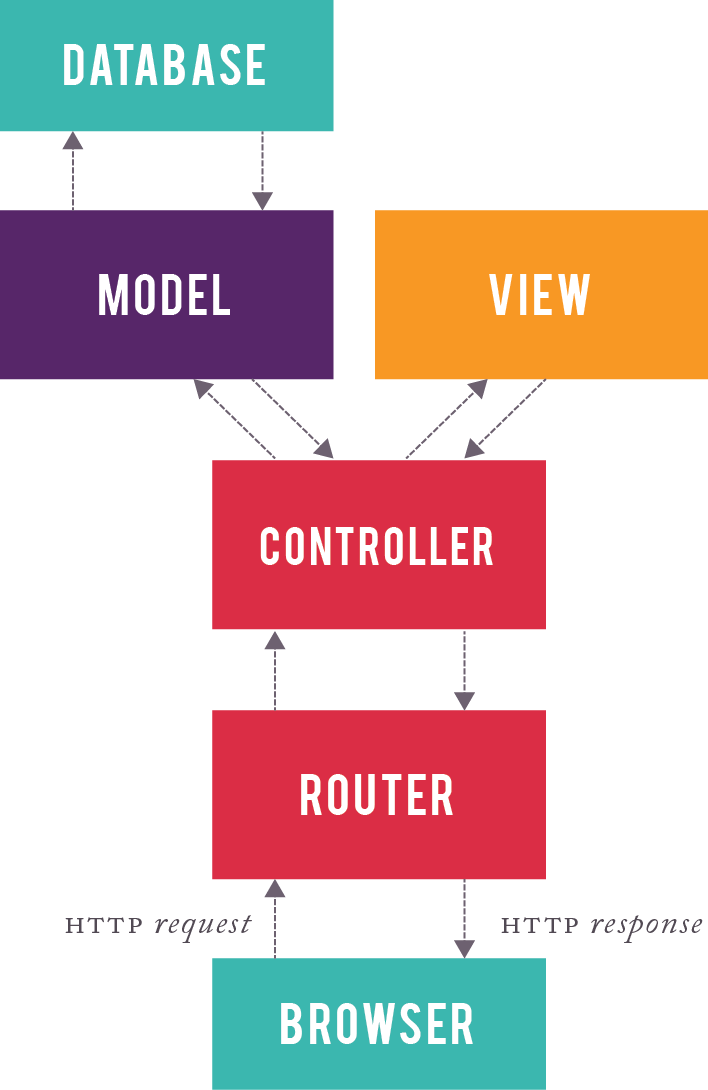
## Rails: Request Life Cycle
The Rails request life cycle works as follows:
1. The **Router** receives an HTTP request from the browser/client, and calls
the controller that will handle it.
1. The **Controller** receives the HTTP parameters, and instantiates the
necessary Model or Models.
1. The **Model** fetches from the database requested objects.
1. The **Controller** passes Models to the View, and renders them.
1. The **View** generates a text reponse (HTML, JSON, etc), interpolating Ruby objects where necessary.
1. The **Controller** response is sent back to the **Router**, and from there to
the client.
## Ember.js: Run Loop
The Ember.js run loop works as follows (don't forget that **Model** and
**Controller** refer now to Ember concepts rather than Rails):
1. The **Router** instantiates a **Model** and sets it in a **Controller**.
1. The **Router** renders the **Template**.
1. The **Template** gets its properties from the **Controller**, which acts as a
decorator for the Model. The Template doesn't know where a property it
displays is defined, the controller will provide it by itself or through its
Model.
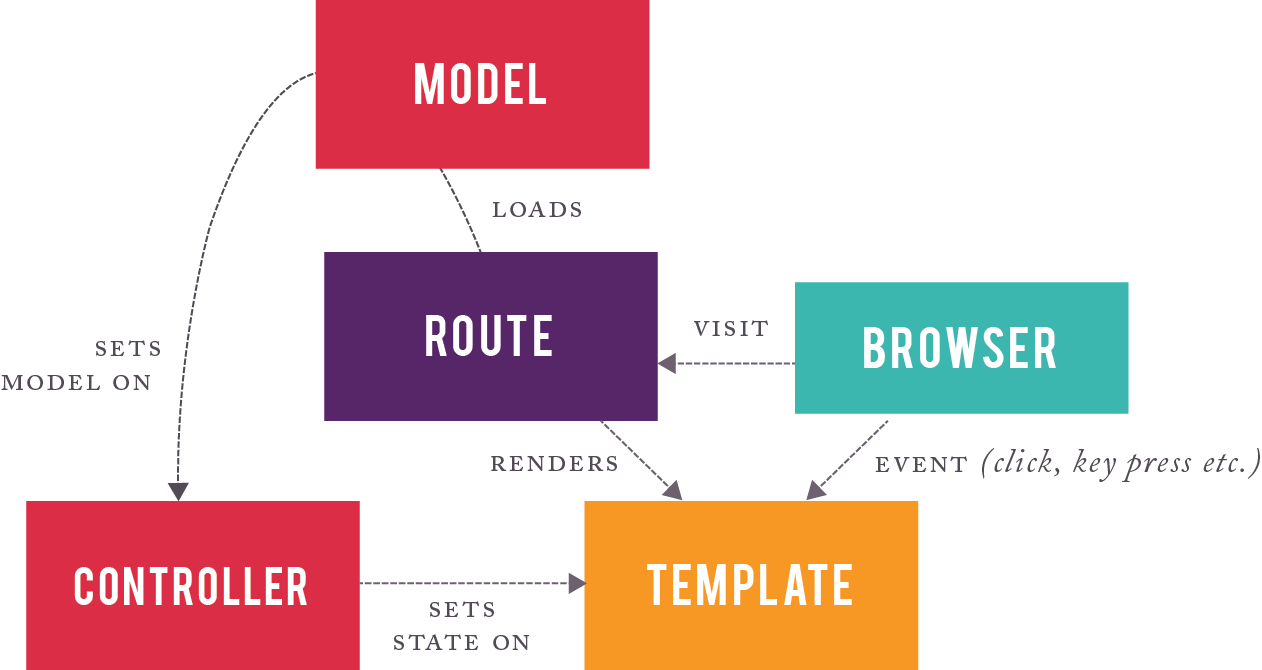
At this point the cycle ends, and it can be restarted by:
- An event (like a click on a link) that triggers an action that updates the
route.
- A new URL is directly visited by
writing in the browser's address bar.
## Model
Models are similar in both frameworks. It is a common situation that a model in
Ember maps one-to-one with a model in Rails.
In Rails almost always a Model is backed by a database like PostgreSQL, whereas
in Ember it is common that a model only lives in memory, and is fetched, changed
or deleted via a JSON API.
Note that in Ember the Template and Model are always automatically in sync
thanks to the two-way binding feature. This means that if we edit in a form an
attribute for a Model, the attribute will change in real time in any place the
model is rendered (let's say, in the title of the page), even if we don't submit
the form or persist the changes. This is another surprise coming from Rails,
where a change in a form is stateless and until we successfully send it nothing
really changes.
## View
It is a good Rails practice to [have simple views, with presenters/decorators
providing any necessary logic][2]. Ember enforces this good practice, with its
Templates being logic-less by nature of its engine, Handlebars. A similar
enforcement may be used in Rails via gems like [curly][1].
Ember has both the concept of Views and of Templates, though Templates are more
akin to Rails Views. An Ember View renders Templates, and it provides re-usable
components and more complex event handling.
## Controller
A Controller in Rails is a Rack application, that talks to Models to return an
HTTP response. A Controller in Ember is a Model decorator, and it's called from
the templates.
## Router
A Router in Rails is responsible for HTTP requests/responses. In Ember a Route
(and not a Router, which is just a mapping between strings and Routes) is
concerned about the current state of the application (what models and
controllers should be set up), and about keeping the URL up to date as application's state changes (like
after a click on a link).
## Final Thoughts
As you dig more into Ember you'll find more similarities and differences. This
blog post should provide a good start to avoid possible confusions due to
similar vocabulary that refers to different things.
[1]: https://github.com/zendesk/curly
[2]: https://thoughtbot.com/blog/tidy-views-and-beyond-with-decorators