---
title: Models That Match Reality
teaser: 'When modeling a domain, it''s important to have our model actually match
reality.
'
tags: design,web,elm,ruby,modeling
author: Joël Quenneville
published_on: 2021-10-12
---
Data modeling is a big part of software design and good models should accurately
approximate reality. Ideas from modeling in other disciplines, sets, and an
aphorism from the Elm community can help us design better models.
Inspired by a discussion
on narrowing types from the Elm discourse.
## What is a model?
When we think of the word "model" in software, we often think of the M in
model-view-controller (MVC). If you're from the Elm community, you might think
of the `Model` type that stores an application's state in the Elm Architecture
(TEA).
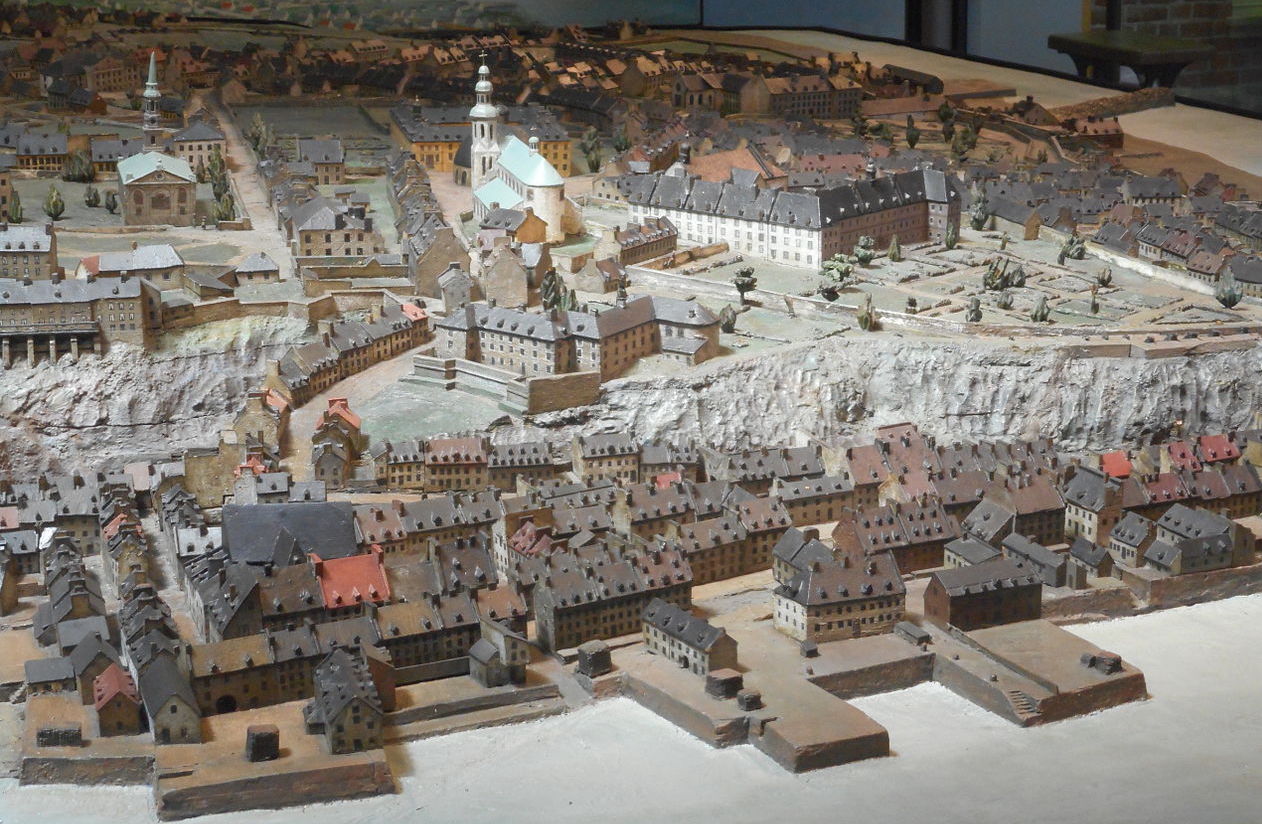
More broadly, models are simplified constructions that try to approximate and
describe reality. A model might be physical, such as a model train or a scale
model of a city. It can also be logical, such as a weather model which is a bunch
of mathematical equations that try to describe weather systems.
Duberger scale
model of Québec City, created in 1806 for the military authorities.
Jeangagnon, CC BY-SA 3.0 via Wikimedia Commons.
## Models in software
What about our models in the software world? They also try to approximate
reality. For example a `Registration` might try to describe some aspects of a
business process in a vacation booking application.
Real-life customers and processes can be infinitely complex and we can't capture
all of that in our modeling. Instead, we approximate and focus on the
characteristics that matter in the context of this particular application.
## Model accuracy
Just because all models are approximations doesn't mean they can't be
**accurate**.
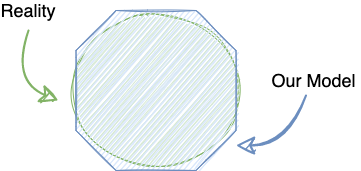
I find it helpful to think of reality and our model as sets. If we had a perfect
model, the set of values our model can describe and the set of values in reality
would be identical. If we drew this as a Venn diagram, the two circles would
perfectly overlay each other.
A model that accurately describes reality
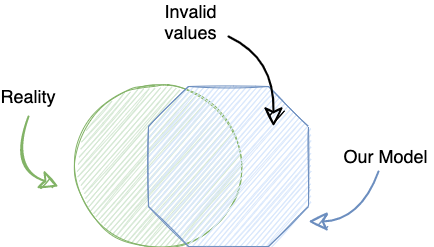
In practice, our models often exclude important details, or more commonly,
include values that are not part of the domain we are trying to describe. As
programmers, we often label these as "invalid values".
An inaccurate model that describes a lot of values not part of reality
## Modeling flights
For example, as part of modeling a registration process we might ask a customer
if they want a one-way or round-trip flight. We might describe this process with
[two booleans]. I'm going to use [Elm] types to show concrete modeling examples
below but the concept applies regardless of your your modeling language.
```elm
type alias Flight =
{ roundTrip : Bool
, oneWay : Bool
}
```
This model is _too broad_. Reality says there are only 2 kinds of flights:
one-way or round-trip and that these two choices are mutually exclusive.
However, our model describes 4 different kinds of flights including 2 that are
nonsensical (both round-trip and one-way, and neither round-trip nor one-way).
In [set terms], we would say that the "reality" set has a **cardinality** of 2,
while the "model" set has a cardinality of 4. Remember, we're trying to get both
sets to be identical so this tells us that our model is too permissive. If our
program gets into one of these states, we will likely get garbage output.
We can try and create a different model that better describes the reality of
flight choices. The following can be read as "a `Flight` is `OneWay` OR
`RoundTrip`"
```elm
type Flight = OneWay | RoundTrip
```
Now, both our "reality" and "model" sets have a cardinality of 2 (and both
contain the _same_ 2 values). Our model is much more accurate.
## Not just types
While the examples in the section above used Elm types, these modeling ideas are
not restricted to typed languages. We could do something similar with a Ruby on
Rails model as well:
```ruby
class Flight < ApplicationRecord
enum direction: [:one_way, :round_trip]
end
```
## Making impossible states impossible
Elm programmers often refer to this kind of modeling improvement as "[making
impossible states impossible]". You'll often hear this brought up in discussions
about what types to use, however the big idea behind it is much broader: align
your modeling with the reality you are trying to describe.
## More on data modeling
Want to learn more about data modeling? Here are some helpful resources from our
blog and around the internet.
* ✍ [Elm Slays a UI Antipattern]
* ✍ [The Three-State Boolean Problem]
* ✍ [Modeling with Union Types]
* 🎬 [Domain Modeling made Functional]
* ✍ [Modeling Currency in Elm]
* 🎬 [Make Data Structures]
* 🎬 [A Number By Any Other Name]
[Elm]: https://elm-lang.org
[two booleans]: https://thoughtbot.com/blog/booleans-and-enums
[making impossible states impossible]: https://www.youtube.com/watch?v=IcgmSRJHu_8
[set terms]: https://guide.elm-lang.org/appendix/types_as_sets.html
[Elm Slays a UI Antipattern]: http://blog.jenkster.com/2016/06/how-elm-slays-a-ui-antipattern.html
[The Three-State Boolean Problem]: https://thoughtbot.com/blog/avoid-the-threestate-boolean-problem
[Modeling with Union types]: https://thoughtbot.com/blog/modeling-with-union-types
[Domain Modeling made Functional]: https://www.youtube.com/watch?v=1pSH8kElmM4
[Modeling Currency in Elm]: https://thoughtbot.com/blog/modeling-currency-in-elm-using-phantom-types
[Make Data Structures]: https://www.youtube.com/watch?v=x1FU3e0sT1I
[A Number By Any Other Name]: https://www.youtube.com/watch?v=WnTw0z7rD3E