---
title: Merck Developer Portal Case Study
teaser: |
  A glimpse into our process from start to finish on a developer portal
  project for Merck.
tags: design,ember,philadelphia,product design,jobs-to-be-done
author: Kyle Fiedler
published_on: 2015-09-14
---

## Some background

In the last few years, Merck has hired more developers in several offices around
the world and adopted newer web and mobile technologies. Because of this, they
realized that their developers had a huge amount of combined knowledge, most of
which was contained in silos. Many people weren't tapping into the expertise or
knowledge of others within the company, or were only using personal networks to
get access to isolated knowledge.

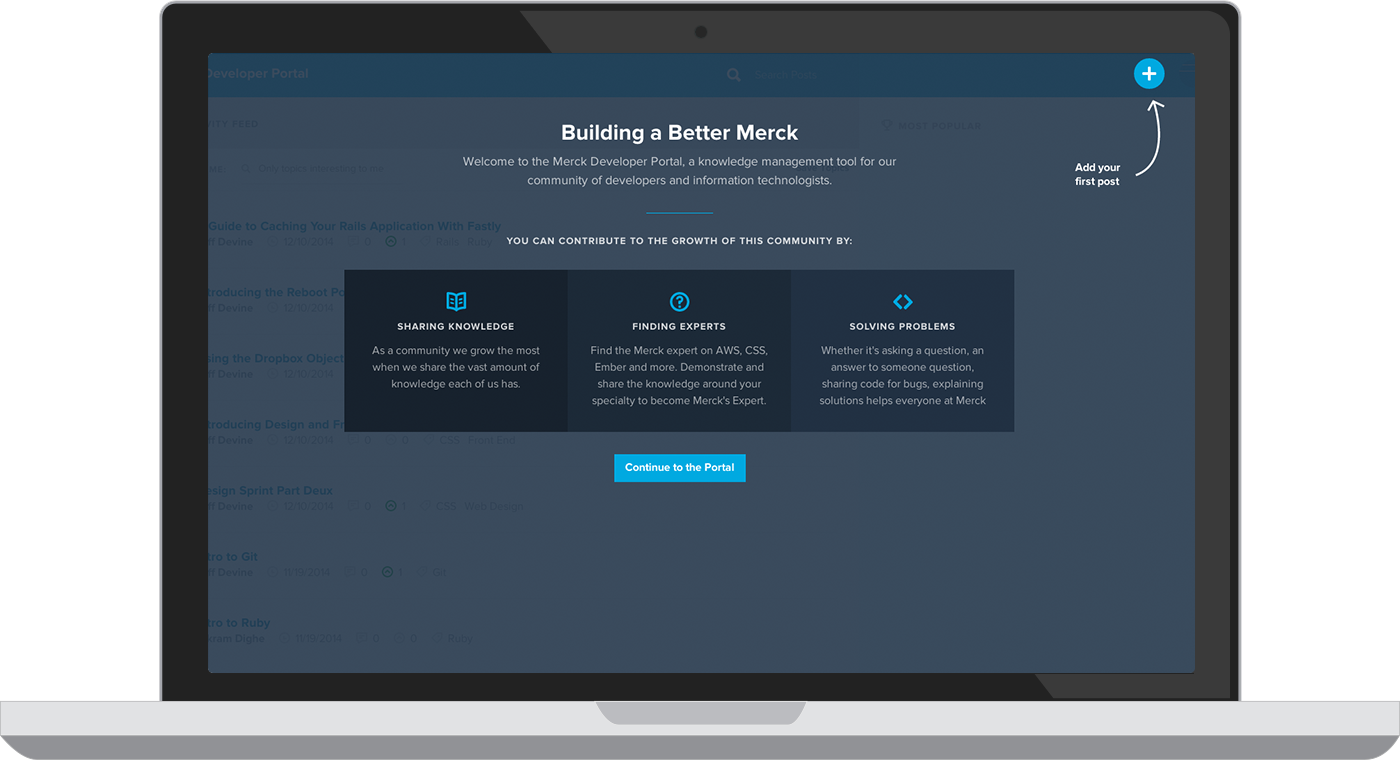
Merck wanted to build a community around their developers in order to make
sharing knowledge easy and a less isolated process. From a business standpoint,
the company realized the impact this might have in saving their developers'
time, as well as increasing the skill level across development languages and
roles enabling their employees to learn and their teams to be more flexible.

<div class="laptop-image">
  <img
    src="https://images.thoughtbot.com/merck-developer-portal-case-study/SgnBuPGpQZCdVSWXvULh_welcome.png"
  />
</div>

<div class="design-sprints">
  <h2 class="section-title">Design Sprints</h2>

  <p>We kicked off the project with two design sprints. During the <a
  href="https://thoughtbot.com/blog/design-sprint-case-study-merck-development-portal">first
  sprint</a>, we both validated and invalidated some of the features when
  testing the prototype. After reviewing all of our notes at the end of the
  sprint, we decided it would be best to conduct another design sprint to build
  upon what we learned from the first sprint.</p>

  <ul class="sprint-images">
    <li class="sprint-image"><img
      src="https://images.thoughtbot.com/merck-developer-portal-case-study/FW8Dlrt7TEKYjPQnvKpU_merck-dot-votes.png"
    /></li>
    <li class="sprint-image"><img
      src="https://images.thoughtbot.com/merck-developer-portal-case-study/ZS4V0eE4RfGQV5uvG3BH_merck-crazy-eights.png"
    /></li>
    <li class="sprint-image"><img
      src="https://images.thoughtbot.com/merck-design-sprint/merck-ordering.jpg"
    /></li>
  </ul>

  <p>After the <a
  href="https://thoughtbot.com/blog/merck-design-sprint-part-deux">second
  sprint</a>, we felt more confident in our solution for the problem. We started
  building a product focusing on duplicating the social events that were already
  happening around the company and enhancing them. We gathered together the main
  categories of conversations that employees were having and sought to amplify
  them. These became our post types and allowed us to better deliver content
  that was interesting to each individual user.</p>

  <img
    src="https://images.thoughtbot.com/merck-design-sprint/prototype.gif"
    class="prototype-image"
  />
</div>

<div class="jobs-story-wrapper">
  <h2 class="section-title">Using Jobs-to-be-done</h2>
  <p>The core product team was small, consisting of one designer and developer
  from thoughtbot as well as one Product Manager on the client team. This
  allowed us to move fast and test the application more iteratively. It also
  allowed for less overhead communication and led to more fruitful conversations
  in-person as well as on Trello and Slack.</p>

  <p>These conversations where enhanced by using <a
  href="https://thoughtbot.com/blog/converting-to-jobs-stories">job stories</a>.
  Jobs stories allowed us to concentrate on the users' needs instead of a
  specific feature set. Because we used jobs stories, our team was more
  empathetic to our users.</p>

  <div class="jobs-story">
    <h3>Jobs story format</h3>
    <blockquote>
      As a [persona/role] I want to [action] so that [outcome/benefit].
    </blockquote>
  </div>

  <img
    src="https://images.thoughtbot.com/merck-developer-portal-case-study/5gsqhP6aRvO56Lhds596_feed.png"
  />
</div>

## Usability Tests and Interviews

Halfway through the project, we noticed during usability testing that there were
remaining problems with our post categories. The differences still weren't clear
to some of our users. We gathered together for one last quick design sprint,
which lasted one day. During the sprint we formulated a plan to refine the
implementation and make it clear to all of the users what the post types were.
We again prototyped and tested our new assumptions. This time we had much more
success, and it the intention seemed clear to our users.

<div class="full-width">
  <img
    src="https://images.thoughtbot.com/merck-developer-portal-case-study/HaBIpehSTqDaab7r2vwq_post.png"
  />
</div>

We continued to interview Merck developers, using jobs-to-be-done style
interviews, throughout the lifetime of the project. During the interviews, we
would ask them about how they use other tools online to validate whether the
application was something they would continue to use over time. We asked them to
use the application as we were building it in order to best continually test new
features. This helped us target the core of the product and refine the user
experience of the main feature set.

<div class="animated-gifs">
  <p>We added some personality to the application by adding animated gifs
  in the least likely of places. This made the platform more fun and engaging
and not just another forum.</p>
  <ul>
    <li><img
      src="https://images.thoughtbot.com/merck-developer-portal-case-study/eoAcKX4kSke85hMYAxOF_404-edited.gif"
    /></li>
    <li><img
      src="https://images.thoughtbot.com/merck-developer-portal-case-study/VGZ6sirwRr2IWrGxtA6c_no-results-edited.gif"
    /></li>
  </ul>
</div>

The Merck team launched the product towards the end of our eight week engagement
to a select group of users to begin populating the community with discussions.
