---
title: 'Internbot Chronicles #4: CI & Test Metrics'
teaser:
tags: playbook,apprenticeship
author: Nick Quaranto
published_on: 2009-05-29
---
Inspired by some of the great talks at [RailsConf
2009](https://thoughtbot.com/blog/railsconf-2009-wrapup) such as [Automated
Code Quality Checking in Ruby on
Rails](http://litanyagainstfear.com/blog/2009/05/07/railsconf-2009-automated-code-quality-checking-in-ruby-and-rails/)
along with [Using metric_fu to Make Your Rails Code
Better](http://onrails.org/articles/2009/05/07/railsconf-2009-day-two), this
Internbot was recently tasked with getting a similar system working for the open
source projects and Rails client sites that live in the thoughtbot ecosystem.
[](http://ci.thoughtbot.com)
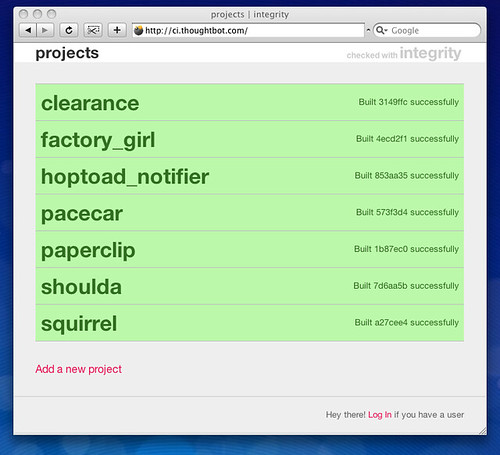
The first step of this process was to get a new CI server up an running.
thoughtbot was using [CruiseControl.rb](http://cruisecontrolrb.thoughtworks.com)
and [RunCodeRun](http://runcoderun.com/) previously, but both had fallen out of
use recently. I had some experience with setting up
[Integrity](http://integrityapp.com), which is a much easier to use system.
Adding a new project is dead simple: plug in your project's Git URL, give it a build script to run
(usually just `rake`) and boom, you've got CI. Integrity also supports
[post-receive hooks](http://github.com/guides/post-receive-hooks), so when we
push commits GitHub tells Integrity to grab the latest changes and get testing.
We also make use of the [Campfire
hook](http://github.com/integrity/integrity-campfire/tree) to let us know the
results of the build.
It was easy to get Integrity itself running, but getting the tests passing for
all of our projects was no simple task. Here's some of the gotchas that I ran
into that might help you out if you're putting together your own CI server:
* Make sure your Rails apps' database tables exist. In hindsight, simply running
`rake db:create:all` would have done the trick.
* Use a Linux distro with an up-to-date version of Ruby that's easily available.
We settled on Ubuntu 8.10 with Ruby 1.8.7 patchlevel 72.
* The build script can take **any** system command, so use it for setting up
your test environment if necessary.
* Builds don't run in the background, so switch them to a different port if you
want to be able to view your projects while builds are running.
Check out our build server at
[http://ci.thoughtbot.com](http://ci.thoughtbot.com) if you want to see the
status of our projects.
[](http://metrics.thoughtbot.com)
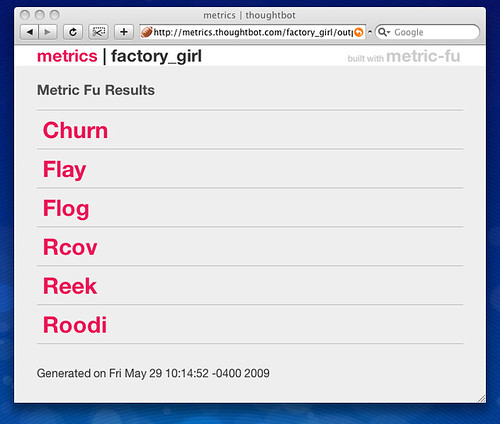
Next up was getting some metrics generated. The
[metric_fu](http://metric-fu.rubyforge.org/) project does a great job of this:
with just one rake task, you can summon stats from
[Flay](http://ruby.sadi.st/Flay.html), [Flog](http://ruby.sadi.st/Flog.html),
[RCov](http://github.com/relevance/rcov/tree/master),
[Roodi](http://github.com/martinjandrews/roodi/tree/master),
[Reek](http://wiki.github.com/kevinrutherford/reek), and more. That's decent for
one project, but for nearly 20 it doesn't work so well. I ended up hacking a
script together that does the following for each project that lives in the
Integrity database:
* Runs metric_fu to generate stats
* Compares the last run to the current one to see if there's any difference
* Alerts Campfire using [Tinder](http://tinder.rubyforge.org/) if there's
changes
* Logs the run in a Google Spreadsheet using
[google-spreadsheet-ruby](http://github.com/gimite/google-spreadsheet-ruby/)
So around 4 times daily we get updates as to how bad good our code is,
and eventually we'll start seeing some trends in the spreadsheets. I also hacked
a custom template based on Integrity's layout so it's easier to browse the
metrics, which is available in [my
fork](http://github.com/qrush/metric_fu/tree/master). The next step is to
integrate the tools into the Integrity build script, which we're still in the
process of deciding [what
factors](https://thoughtbot.com/blog/simple-test-metrics-in-your-rails-app-and-what-they)
will determine a failure.
The metrics are up and available at
[http://metrics.thoughtbot.com](http://metrics.thoughtbot.com) if you'd like to
browse around.
[](http://metrics.thoughtbot.com/hoptoad_notifier/output/reek.html)
Both of these projects have been a lot of fun to work on. So far there's no
penalties for breaking the build, but there are plenty of [NERF
guns](http://lh4.ggpht.com/AGWSpilot16/R-vWmqnaDMI/AAAAAAAAArs/k4OxhzrZFQ4/s400/Nerf+N-Strike+Vulcan.jpg)
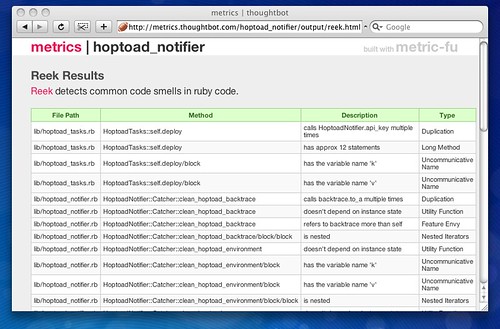
around the office if we feel the need for retaliation. The Reek and Roodi
metrics results have been quite enlightening and they seem to give great
suggestions for refactoring. As for the trends, perhaps I'll report back in a
future edition of the Chronicles on the progress!