---
title: How to define and prioritize features for your MVP
teaser: 'Starting a business and building an MVP is hard, really hard. In fact, according
to CB Insights, 70% of startups will fail. Learn how to reduce your risk of failure
by building only the features you need in your MVP.
'
tags: startup,design,design sprints,process,mvp
author: Adrian Rogowski
published_on: 2018-07-04
---
## Starting a business and building an MVP is full of risks
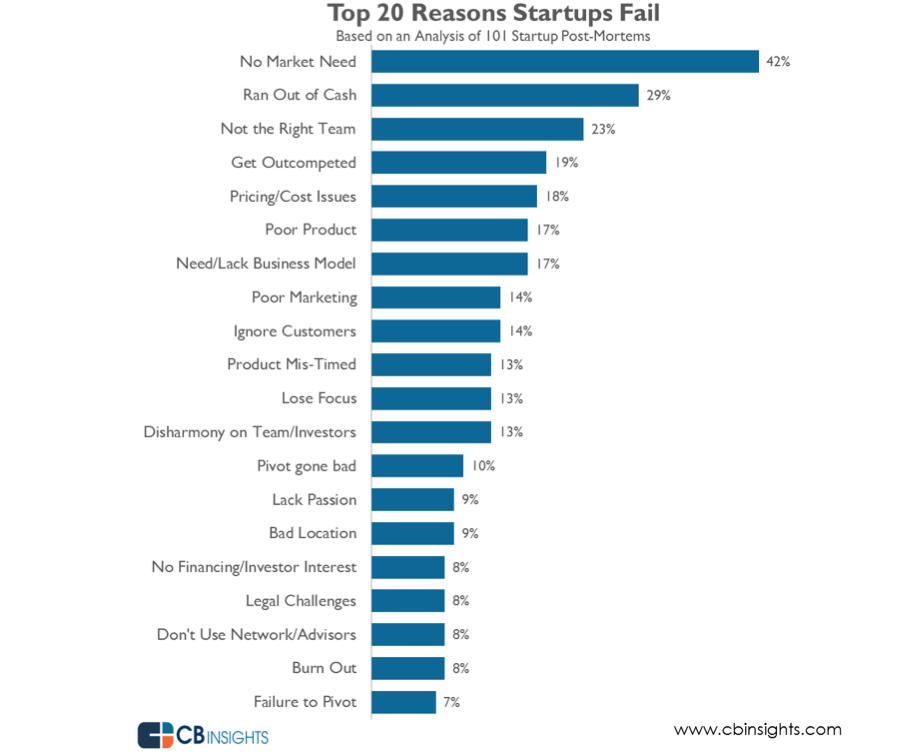
Starting a business is hard, really hard. In fact, [according to CB Insights,
70% of startups will fail][startup-failure] and according to this analysis of
101 failed startups, the top two reasons for failure are **No Market Need
(42%)** and **Ran out cash (29%)**. Both of these reasons highlight just how
important it is that your company builds only what is necessary. In the early
stages, the stakes are too high.
[startup-failure]: https://www.cbinsights.com/research/startup-failure-post-mortem/
The top 20 reasons startups fail. Source: CB
Insights
## What is the goal of an MVP?
The goal of your minimum viable product (MVP) should be to prove there is
product market fit while taking on the least amount of risk possible. Founders
are often overly excited about their ideas and eager to start building features
without proper planning. They may gloss over assumptions they are making, both
about their product and their customers.
During the earliest stages of your company, it is especially important to talk
to your potential customers and gain insight as to how they might use your
product. We call this work: [Validation](https://thoughtbot.com/blog/validation-the-best-tool-to-de-risk-and-inspire). At thoughtbot we achieve better product outcomes by running product
design sprints. A product design sprint (or PDS) helps us quickly understand the
problem and get real feedback from customers.
Both the design sprint process and the initial build of a product should be
focused on these 3 things.
1. Proving product market fit (Is there a need for this product? Will you be
able to monetize the product?)
2. Validating high risk assumptions (Example: AirBnb - People will let strangers
live in their homes and customers will be willing to stay in someone else’s
house)
3. Quickly getting actionable user feedback (Put a real prototype, paper or
digital, in the hands of users to learn what next steps should be)
## Define the problem your MVP solves and what makes your solution unique
As a founder you need to get to the core reason why someone would use your
product. There are a number of important questions you should be able to answer
in order to reduce the risk of building a product without market fit.
### “What problem does my product solve?”
Answering this question is the first step to understanding your customers. It is
surprisingly easy to come up with solutions to problems that don’t actually
exist. It’s not about what your product does, it’s about the problem it solves.
### “Who is having this problem?”
This is another way of asking yourself who your target customer is. Founders can
be defensive about their ideas and say things like “Anyone and everyone could
use this”. Be as precise as possible because in the early stages you’re not
going to be be able to build a product for everyone.
### “How big of a problem is this?”
Is this the type of problem people are having daily or is it a minor
inconvenience they will experience only once or twice a month? Just because your
potential customers are having a problem, doesn’t mean that it is enough of a
pain point for them to use your product.
### “How are people solving this problem now?”
Asking this question will give you more insight into how big the problem is, but
more importantly, it will start putting users at the center of your product
decisions. You might find out that there is actually a way bigger problem that
your product doesn’t address and it would be better to focus your efforts on
solving that problem instead.
### "What is your value statement?"
Your unique value proposition (UVP) should clearly explain how your
company/product is uniquely equipped to solve this problem and what separates
you from your competition. You have likely identified that people already have
workarounds to the problem you are solving. Getting clear about why people would
choose your product to solve their problem over others will help as you go out
and try to sell your idea to customers and investors as well as narrow in on
what features should be prioritized.
[Our Customer Discovery Playbook](https://thoughtbot.com/playbook#customer-discovery) goes into greater detail in how to find customer, product, and strategic focus including actionable tips for conducting research and asking questions.
## Distinguish between must-haves and nice-to-haves for your MVP
As you’re answering these questions, you’ve likely also come up with a large
number of ideas of what your app *could do*. Remember that now is the time to
hone in on what your MVP *needs to do*.
Ask yourself: does this feature need to be included to validate your product?
Does it align with your value statement? Remember that your goal is to build the
absolute [minimum needed to validate your product idea](https://thoughtbot.com/blog/building-your-product-from-zero-to-mvp) while taking on as little
risk as possible.
Make sure you are only including features that will allow you to prove product
market fit. Sure, at scale things might break down if you don’t have an
efficient admin portal, but you’re not there yet, you’re still fighting to get
your first set of customers. Think of software as a last resort and try to think
of other ways to handle specific edge cases rather than building features. This
might mean that you have to deal with customer requests manually but getting to
the point where this becomes overwhelming is a good problem to have because it
means you are gaining traction. Strip the feature from initial launch and put it
back on your back burner and revisit it when it becomes necessary.
## Learn from feedback and iterate your way to success
It’s important to remind yourself that your MVP is not the final version, nor
will there ever be a *final* version! It will evolve over time. Software is
unique to other businesses because of the speed at which you can make major
changes and release new features. It’s better to release fewer features and get
feedback on what to build next than it is to wait and release a more flushed out
product only to realize customers don’t want it.
Instagram is a great example of successful iteration based on listening to
customer feedback. It started as a location sharing app with a picture sharing
feature. Fast forward to present day and they've created a new social media
category based solely around picture sharing - what their customers really
wanted.
As an entrepreneur you have to accept that there will be failures along the way.
It is important to allow yourself to fail fast and fail often. The longer you
take to release your product, the more risk you take on, so don’t worry too much
about what your initial release looks like. Remember what LinkedIn Founder Reid
Hoffman said: “If you aren't embarrassed by the first version of your product,
you shipped too late.”

thoughtbot is a team of talented designers and developers who help founders
[plan, design and build the right MVP](https://thoughtbot.com/services/mvp-design-development). We’ve helped hundreds of startups like [Folio](https://thoughtbot.com/case-studies/folio) and [Neighborhood Alerts](https://thoughtbot.com/case-studies/neighborhood-alerts) quickly validate their products
and accelerate their time to market. [We’d love to help you build your product
too!](https://thoughtbot.com/hire-us)