---
title: Deadlines
teaser: The comet of success will lead your team to victory.
tags: process,business
author: Matt Sumner
published_on: 2017-09-11
---
Deadlines are a tool. There are good and bad deadlines. This post is going to
outline how you could be using deadlines to superpower your project as well as
some of the pitfalls that we see many organizations fall into.
The following is taken verbatim from the excellent post [How Do You Decide When
a Design is "Finished"?](https://thoughtbot.com/blog/how-do-you-decide-when-a-design-is-finished)
> ## Am I making good use of my time?
> The awesome thing about deadlines is that it forces you to make better
> decisions faster because there simply isn't enough time to thoroughly explore
> everything. If the project is on schedule however, then I'll definitely take
> the time to massage the design in areas that are most important though this
> also serves as a reality check for when the time is nearing to move on.
>
> Kim Goulbourne
And this is entirely true. Without setting some line in the sand we might never
end up shipping a product. Deadlines are a wonderful tool for motivating the
process of shipping.
Deadlines inherently enforce a time constraint which can lead to lowered
standards. This in turn can lead to:
* Technical debt due to rushed implementations.
* Poor user experience due to restricted time to iterate on the design.
* Less creative solutions as taking the "safe" route is more predictable.
* Missed deadlines leading to mismatched expectations.
* Team burn out.
* Broken dreams.
* Hurt feelings.
## Set Deadlines with the Entire Team
When determining your deadline make sure you've got a diversity of viewpoints
providing input. Setting a deadline with only input from your sales team is
potentially going to result in broken promises and shattered dreams. Only
talking to your development team may end up with deadlines that lack a greater
understanding of your customers wants/needs and ignore other time related events
such as conferences.
> Deadlines refine the mind. They remove variables like exotic materials and
> processes that take too long. The closer the deadline, the more likely you'll
> start thinking waaay outside the box.
>
> Adam Savage
The worst thing you can do is arbitrarily choose a deadline with no input. When
you do this you've shown a complete disregard for your team and set an
expectation that no one else believes in. Your deadline might be entirely
reasonable but for a healthy working relationship everyone needs to feel heard
and valued.
There is a big difference in how one approaches a deadline set by oneself and
one set by some external force. Make sure those that need to deliver on the
deadline buy into it.
## Always Remember: Deadlines are Flexible
> I love deadlines. I like the whooshing sound they make as they fly by.
>
> Douglas Adams
During my professional career I've rarely encountered deadlines that couldn't be
moved. We set deadlines to avoid consequences, but often these are imagined and
are never encountered. The consequences of rushing during the panic of an
impending deadline are all too real and encountered all to often. Take a breath,
re-assess and change the deadline.
Check in every [retro] with the status of a deadline. As the deadline
approaches, your team will have more information and be able to give far more
accurate predictions for if the deadline will be met or not. The earlier you
know there is a real risk of not making a deadline, the earlier you can react by
moving the date or reducing scope.
[retro]: https://thoughtbot.com/playbook/planning/meet-weekly-to-discuss-successes-failures-and-plans
## The Comet of Success
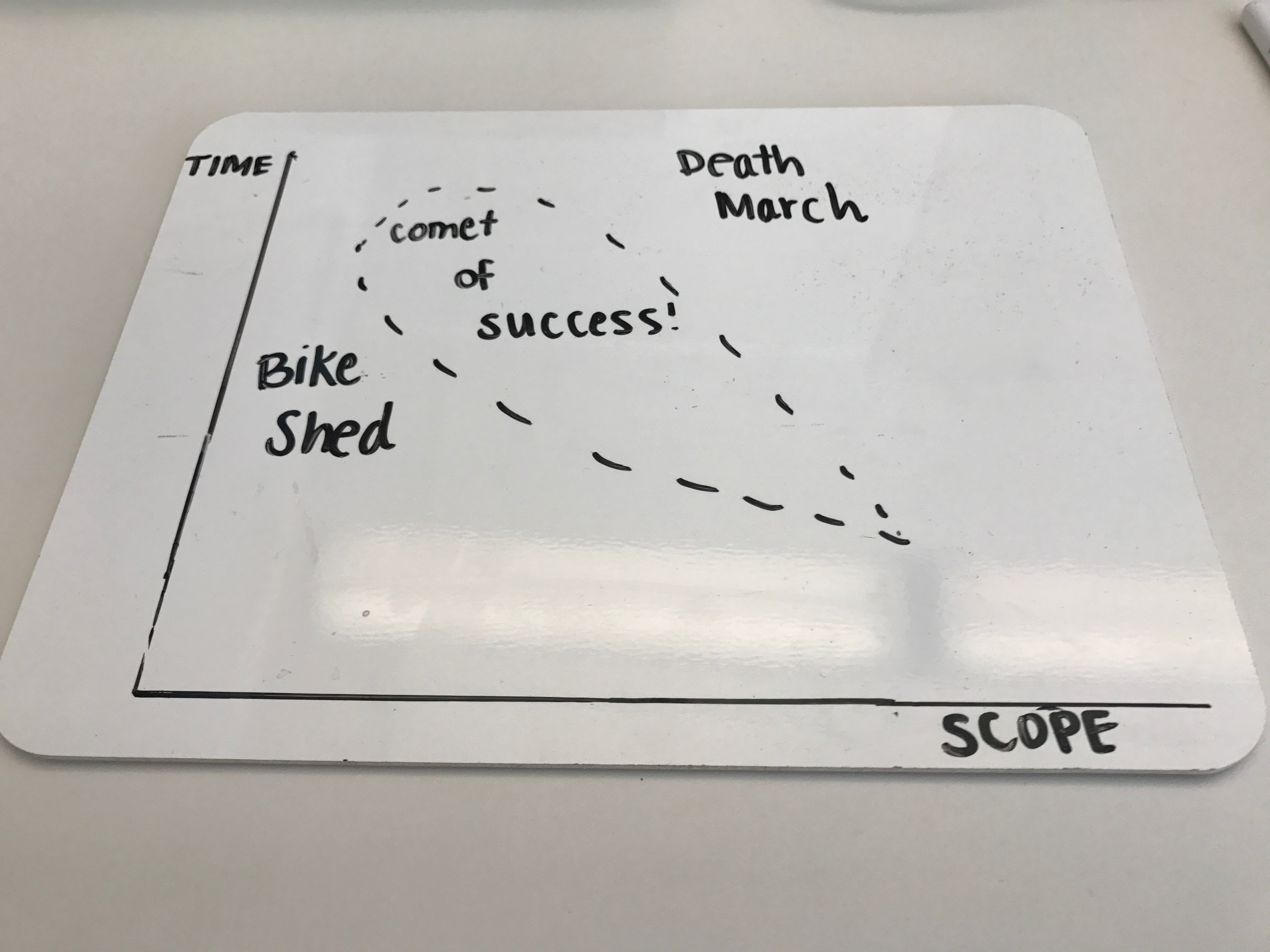
We've found that success occurs when there is some flexibility in both scope and
timeline, although we've had more experience with fixed deadlines. Our projects
will often have a fixed budget which equates to a fixed amount of time and we
expect to deliver a product.
You should avoid having extremes in either capacity. Having inflexibility on
both sides sets your team up for failure when they're unable to react to
changing conditions. Having complete flexibility on both sides means there is no
pressure to produce anything.
I'm going to call this "sweet spot" the Comet of Success. Each axis represents
how inflexible the scope and time are. (0, 0) is complete flexibility in scope
and time and (1, 1) is a due date that cannot change and scope that is set in
stone.
## Celebrate Met Deadlines
When everything goes right, take a moment. Bask in your success. The positivity
generated from the simple act of celebration brings teams together and grounds
you towards a common goal. Success!
## Some Additional Reading
* A Wall Street Journal article suggesting [deadlines do more harm then
good](https://www.wsj.com/articles/the-inner-workings-of-the-executive-brain-1398388537?tesla=y)
* [A Case for and Against Stressful
Deadlines](https://www.fastcompany.com/3030567/the-case-for-and-against-stressful-deadlines)
* [Time Pressure and Creativity in
Organizations](http://www.hbs.edu/faculty/Publication%20Files/02-073_03f1ecea-789d-4ce1-b594-e74aa4057e22.pdf)
* A 1983 study on the effects of [Effects of Motivational Orientation on
Creative
Writers](http://pages.pomona.edu/%7Eajr04747/fall2008/math58/papers/amabile_1985_psp-48-2-393.pdf)